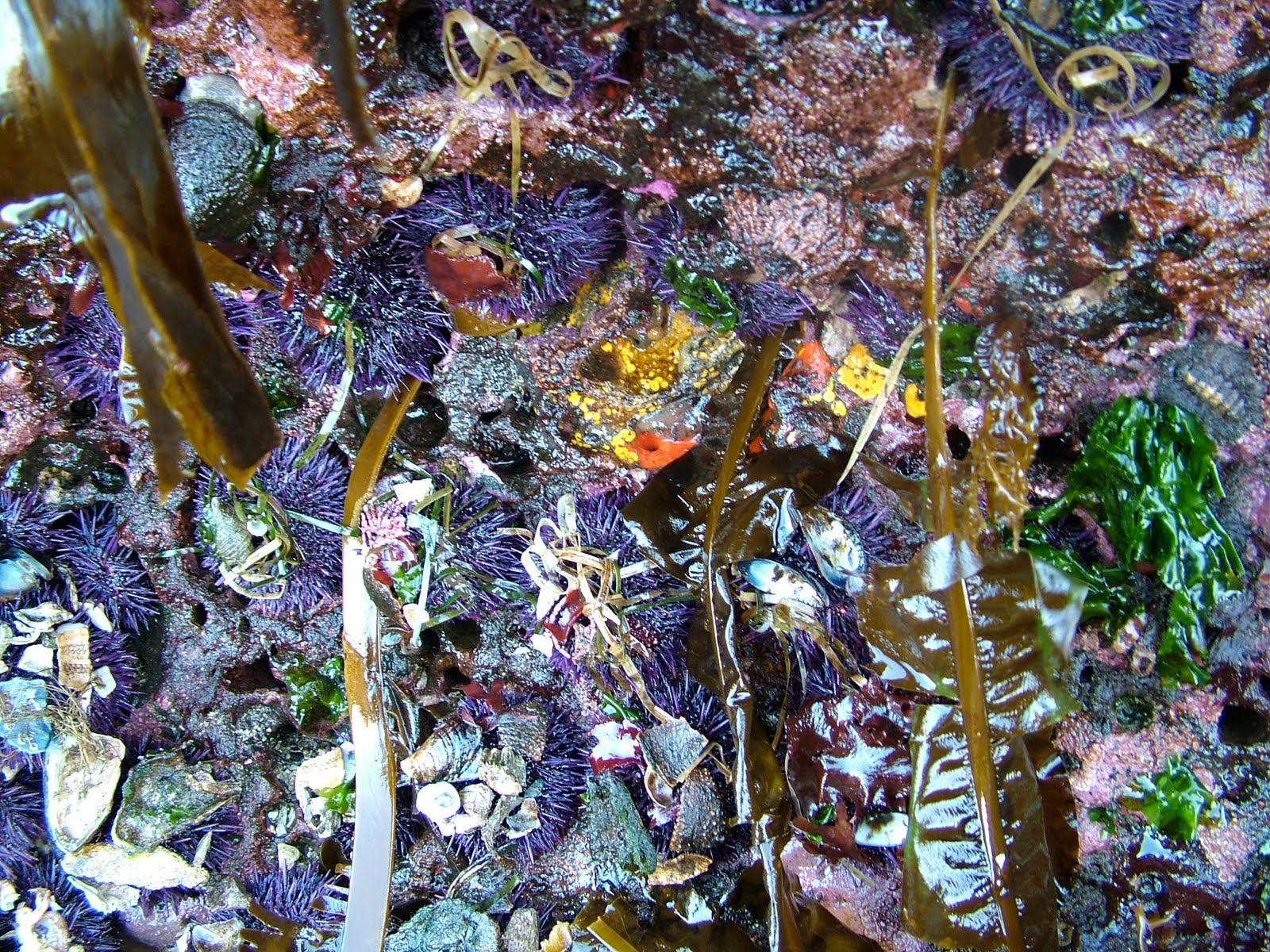
Recent studies have shown that sea urchins have photoreceptors around the tips and base of the tube feet....cool. They have genes that code for opsin which has function in the human retina. This is not too surprising since echinoderms are relatively close relatives of the chordates....us. We share some developmental traits with the Echinoderms...sea cucumbers, sea stars, sea urchins, etc. Among the invertebrates there are only about 6 groups that share our development strategy out of some 30 phyla. We are deuterostomes as opposed to the rest of the lot who are protostomes. If you have forgotten your developmental biology that means: Initially development from a single fertilized cell develops into a tiny ball of cells called a blastula. Soon a little dimple develops on the ball and pushes inward forming the gut....in protostomes this little dimple becomes the mouth (Protostome = mouth first) later an anus will form. In deuterostomes (mouth second) the dimple becomes the anus and only later does the mouth form.
Echinoderms and Chordates are deuterostomes....which leads us to the SAD TRUTH.
Wednesday, July 6, 2011
Sunday, July 3, 2011
Holiday Hoedown at Schmitz Park Beach....Do Sa Do!
Friday, July 1, 2011
Where have all the soldiers gone??,,,er make that Midshipmen.
Spring and Summer are prime Plainfin Midshipman spawning seasons. The Plainfin Midshipman is a rather cool looking fish....although rather drab brown its body has multiple rows of shiny brass buttons...thus the Midshipman name. In some places...like California the buttons can be made to light up by the fish...function unknown. In Washington State this bioluminescence is not found....and this has to do with the diet of the fish; they don't get the right kind of copepods to feed on up here. There are two types of males...type 1 and type 2. Type 1 males dig nests under rocks and sing to attract females...if the female likes the tune she will enter the nest and lay eggs that are attached to the bottom of the rock. After fertilizing the eggs the male will guard the eggs until the young fish depart. Type 2 males are sneaky suckers...looking like females and sounding like them. Their sinister plan is to fool the type 1 male into believing they are females and allowing them into the nest where they will wait until a true female spawns and then attempt to fertilize the eggs before the type 1 gets wise. A few years back Blakely Harbor, Bainbridge Island WA was rich with nesting Midshipmen..all guarding eggs. Today I found none. But somebody else did...the intertidal bandit, who ate three Midshipmen in about 15 minutes. So now I know where at least three Midshipmen went and no doubt many more.
| Midshipman male with eggs |
![]() |
| Juv. Midshipmen ready to leave nest |
| Blakely Harbor Bainbridge Island WA |
| Blakely Harbor Bainbridge Island WA |
![]() |
| End of a Midshipman |
![]() |
| Midshipman #2 |
![]() |
Thursday, June 30, 2011
Death of the Cockle
Gulls feed on just about anything they can find........that's why they frequent dumps so often. On the beaches of Puget Sound they can be found with sea stars, worms, sea urchins, crabs, clams, mussels, fish and just about anything else they can swallow. Cockles are sturdy shelled clams that only bury themselves a few centimeters in the sand. Gulls can see the siphons sticking up at the surface and dig them up quickly. Once caught it's a matter of getting the cockle open by dropping it from flight until it finally breaks and is open for consumption. While gulls don't usually share they will sometimes if it happens to be one of their offspring begging. In the series of images below an adult gull captures a cockle, drops it till it breaks and then shares it with a juvenile gull which may be its offspring.....sharing with the crow...no way.
Algae-Seaweed-Sea Grass
In long past years most students of biology heard the same story over and over......Every living thing depends of the energy of sunlight. Now we know photosynthesis is not necessary, and impossible in the deep ocean, and that chemical energy systems from the earth itself can power life. We still don't know what percentage of life is powered by the sun and what gets energy in other ways but here on the surface it looks like photosynthesis is doing all right.....I noticed it's doing really well with my lawn (why I still have one of those I don't know).
In Puget Sound there are some 500 or more species of seaweeds, two species of sea grasses plus an unknown but large number of algal plankton species. The images below attest to the diversity of the seaweeds and phytoplankton but just scratch the surface. For a more in depth look (only about knee deep) check out the presentation Algae and Seaweeds under Buzz Links on this page.
| Nori |
| Green Rope |
| Encrusting coraline algae |
| Surf grass |
| Ribbon Kelp |
| Feather Boa holdfast |
| Parasitic sea weed on red algae |
| Coraline Seaweed |
| Bubble seaweed |
| Stiff Stipe seaweed |
| Sugar Kelp |
| Ulva - Sea Lettuce |
| Japanese Eelgrass |
| Wireweed...Sargassum |
| Fucus - Rockweed |
| Codium - dead man's fingers |
| Coraline branched seaweed |
| Sea Sacs |
| Feather Boa |
| Succulent seaweed |
| Acid Kelp |
| Bull Kelp and 5 Rib Kelp |
| Red Lace Seaweed |
| Young Fucus - Rockweed |
| Fish eggs on Sargassum |
| Mixed Red seaweeds |
Wednesday, June 22, 2011
Sashimi for Lunch
While I've posted lots of Osprey images on the blog, I'm going to be redundant and post a few more.
The Osprey is a rather unique bird, in its own family, mainly a fish eater, but will take other prey on occasion. Males are stuck with feeding the female during courtship and incubation as well as doing some of the incubation. Not a bad deal if you are a female. Once the eggs hatch the young are fed regurgitated food for the first few weeks....brought by the male. Ospreys are usually seen flying in a pattern over the water at a height of 30 to 100 feet looking for fish which they capture by plunge diving feet first. However, at Alki beach in Seattle there is at least one Osprey that prefers to stand on a lamp post and survey the water for potential meals. If the bird starts bobbing its head from side to side you can bet a fish has been observed and often this is a signal that flight is eminent. The images here are form Alki beach of that bird having lunch today 6-22-11. Sushi Forever!
| Off to hunt |
Great catch |
| success |
| Ah, Sashimi |
| Yum |
| always a pest |
Monday, June 20, 2011
Noctiluca, the Night Light (Red Tide not)
This is the peak season for plankton blooms of certain species. One is Noctiluca (night light) which colors the water like tomato soup. Noctiluca is non-toxic but because of the term RED TIDE many people associate this with toxic plankton blooms known as HAB's or Harmful Algal Blooms. Noctiluca is a dinoflagellate that does not photosynthesize but preys on diatoms and other plankton. There are two species of phytoplankton in our area that can be toxic but do not color the water. If you collect some of the Noctiluca you can easily see the individuals with a hand lens and at night it will give of a flash of blue/green light when disturbed....or less often just randomly. The light likely has some function. In the Sea of Cortez I observed dolphins, sea lions and pelicans feeding on a dark night and they seemed to be keying in on the prey fish by following the glowing trail the fish made when swimming. While dolphins and seals could use other clues to track a prey fish it is most likely that pelicans flying overhead could easily spot the light from the fish's wake......we were kayaking at the time as causing fish to swim away from the kayaks just by moving through the water. So perhaps Noctiluca illuminates its predators allowing their predators to catch them and thus retucing the number of fish predators on Noctiluca. That would make Noctiluca very bright indeed. The biolumisence was so strong that the entire inside of the kayak was lighted by the flashing of the Noctiluca under the boats. For more information visit: http://www.ecy.wa.gov/programs/eap/mar_wat/mwalgae.html
| Noctiluca Seahurst Park 6-17-11 |
| Noctiluca (Night Light) |
Subscribe to:
Posts (Atom)