Monday, July 14, 2014

HAPPIER NOTE FROM SCHMITZ MARINE RESERVE WEST SEATTLE

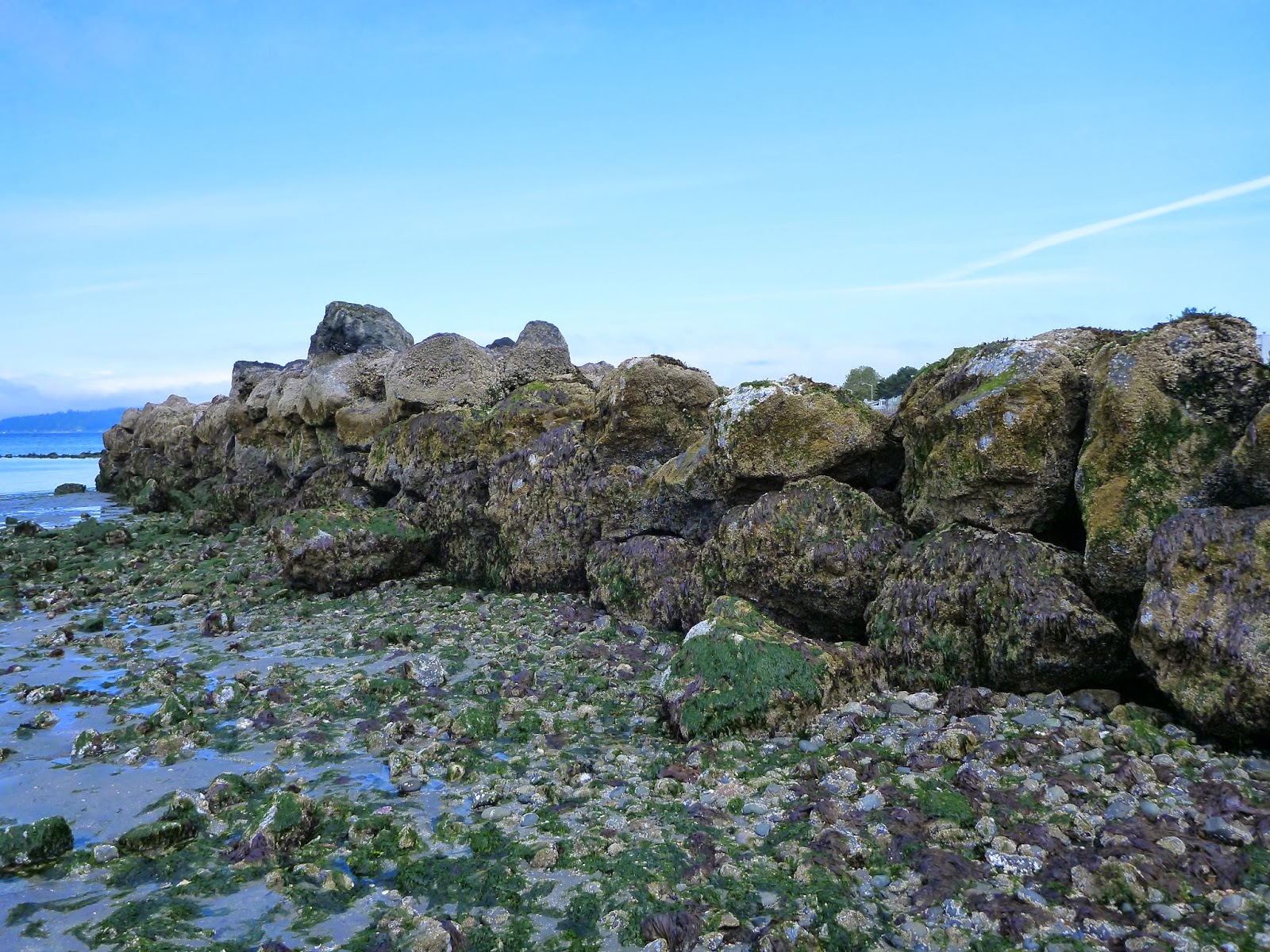
7-13-14  Schmitz Marine Reserve
While there was no official Sea Star Wasting Syndrome survey completed for Schmitz Marine Reserve it was good to see a population of  Pisaster ochraceus and Evasterias t. that for the most part appeared healthy.  The wasting syndrome was present but in only about 10-15% of the population.
In addition one 12 inch Sunflower Star was seen and also appeared healthy.  The seaweed cover was extensive so it is very likely that many sea stars were not seen, so while good news it should not be taken to mean anything positive in the way of a decline in the syndrome in the local sea star population.  A number of juvenile stars were also seen and appeared healthy.
It was a good day for Moon Snail, Sea Lemon and crab observing.....as usual.
A California Sea Cucumber was an unusual find as they are usually in deeper water.  A tiny Sand Dollar was seen on another Sand Dollar.....smallest one I've ever seen on the beach.
It was great to have the extra eyes of Avery and Liz to help spot the critters hiding in the seaweed.
While Seattle was due for 91 deg. heat the beach was kept comfortable by an good north breeze off the water.  Gretchen held her annual Seaweed Foraging class and served up some great seaweed snacks and dips for chips........too bad the Parks do not allow beer.  A few more days of minus tides and then the next good series is in mid August and that's it for good low tides this summer.


Avery (excellent naturalist) with California Sea Cucumber

Avery meets the Moon Snail (meets not eats)

Hairy Sea Squirt

Lined Chiton and White Sea Cucumber

Lion's Mane Jellyfish

Liz and the Moon Snail

Mottled Star

Noble Sea Lemon

Orange Ribbon Worme

Rock Oyster (False Jingle Shell)

Tiny Sand Dollar on large Sand Dollar

12 inch Sunflower Star (appearing healthy)
 

Saturday, July 12, 2014

HOPE ISLAND - HAMMERSLEY INLET - SEA STAR HUNT

JULY 11 2014
On a kayak trip to South Puget Sound we circumnavigated Hope Island State Park and explored about 1/2 mile up the south side of Hammersley Inlet looking for sea stars  This are was home to a large healthy community of various species of sea stars just last year.  Purple, Mottled, Giant Pink, Leather and Sunflower Stars were abundant in the intertidal and subtidal.  Sea Star Wasting Syndrome has hit this area hard.  While we would expect to see 100's of sea stars on a trip like this in the passed but we almost came up empty this trip.  In all we observed at total of 2 Leather Stars, 1 Mottled Star, 3 Giant Pink Stars, and 1 small Sunflower Star.  Water visibility was about five feet so we were able to check both the exposed shore at the minus 2.8 ft. low tide and the subtidal down to about 3 feet..  All the stars seen were in the subtidal except for the small  Sunflower Star.  All the stars appeared to be healthy but it was difficult to know because of the visibility in the water.  Some stars were likely missed due to kelp coverage in many areas, but large boulders that normally are sea star rich were totally without stars.  If our survey is even close to accurate it would mean that this area has lost over 99% of the past sea star population in these species.

The images below show sea stars in the area from previous years trips and images from the July 11 2014 trip.

Giant Pink Pisaster 2001

Mottled and Purple Stars 2001

Mottled Stars 2001

Purple Stars 2001
Hammersley Inlet 2014

Hammersley Inlet 2014

Plumose Anemones on log 2014

Hammersley Inlet 2014

Hope Island SP  2014

Raccoon Hope Island 2014

Mottled Star 2014

Gretchen Hope Island 2014

Kelp cover Hope Island 2014

Red Rock Crab dug up by Raccoon 2014

Crab being eaten by anemone

Mussels on downed tree branch 2014

Large mussel and barnacle clump on downed tree...sea star food  2014

Bering Hermit Crab in broken Moon Snail shell 2014 Hope Is.

Only Sunflower Star found on kayak trip 2014

Strange clam shell with partial Moon Snail drill hole  2014

Gretchen and commercial clam diggers 2014

Thursday, June 26, 2014

JUVENILE SEA STARS ON LOCAL BEACHES

While we have been bombarded with bad news concerning the situation with sea star wasting syndrome on local beaches, not to mention the West Coast from B.C. to Mexico, there is a ray of sunshine out there.
There seems to be a healthy and large population of juvenile stars of both the Purple and Mottled species (Pisaster ochraceus, Evasterias troschelii) in Puget Sound.  Usually the juveniles hide out under rocks in Summer and are not often seen, but this year they are seen in some places out in the open during the day.  During our survey at Constellation Marine Reserve in February we observed 15 juveniles in our study area in the open......none are seen there now in the Summer but they are quite common under rocks and on the underside of Moon Snail sand collars.   A block of old bricks turned up 8 small stars...of both species.  Hiding under rocks no doubt makes them much less vulnerable to the local gull population.  In Winter the gulls are not actively feeding at night and the little stars stay more out in the open.  Winter also provides cooler temperatures and no damaging UV light from the Sun.  While there have been some sightings of small stars with wasting syndrome most appear to be healthy.....hopefully they will stay that way as they increase in size and age.

Special thanks to Professor Joel Elliott of the Biology Department at the University of Puget Sound for additional information concerning sea star wasting syndrome and local populations of young stars.

Sea Star Wasting article in Seattle Times     http://seattletimes.com/html/localnews/2023950088_seastarwastingxml.html
Mottled Star on Moon Snail sand collar

Mottled Star on sand collar

Mottled Star on sand collar

Juvenile Stars on brick block

Purple and Mottled Stars (small)

Purple Stars (small)

Purple Stars with Frilled Whelks


Friday, June 20, 2014

SEA STAR WASTING SYNDROME - UPDATE

Click on the link below for the latest update on Sea Star Wasting Syndrome:


http://registerguard.com/rg/news/local/31745201-75/stars-sea-harvell-scientists-starfish.html.csp

Additional UPDATE 6-25-14
Two additional surveys were completed on June 24 and 25.
The first survey was completed at the North end of Constellation Marine Reserve and showed an infection rate of 44%.
The second survey was completed at the breakwater just South of the Constellation Marine Reserve boundary at Alki South.  The infection rate was 82% with 7 dead stars counted.

Gull eating sea star with wasting syndrome

Alki S. Breakwater  82% infection level


Sunday, June 15, 2014

HOW TO COMPLETELY RUIN A GUY'S FATHER'S DAY

While exploring the beach at Schmitz Park I discovered a Moon Snail (common event) that was almost completely above the surface...only a little buried in the sand.  I picked it up to show some of the beach goers and do some natural history.....geeze I'm a ham.
Upon lifting the snail I quickly noticed that something was hanging out from the mantle....some little pink thing that I had not seen before.....It stuck me that it was not likely the mouth, but I checked around for clams in the area and found none...but I did find another Moon Snail directly under the location where the first one was before I picked it up......BRAIN FLASH.... this is a male Moon Snail and that little pink thing is his penis.....I just broke up a love affair in the sand.  This poor guy just missed his chance to become a father on father's day because of me......how embarrassing.  The plus side of all this privacy invasion is that I had finally, after 40 years, found a Moon Snail that I could definitely sex as a male.  I could sex females before because I caught them in the act of laying eggs which males, of course, don't do.
So below are a series of images....first one is how I found the Moon Snail;  second one of the Moon Snails penis and lastly the pair, male and female side by side....and no doubt not happy with me.
HAPPY FATHER'S DAY....DADS...evidently you had better luck than the Moon Snail.


Thursday, June 12, 2014

CLUBHOOK SQUID (Onykia robusta) WASHES UP ON ALKI BEACH

A seven foot Clubhook Squid (Onykia robusta) washed up on Alki Beach on 6-12-14.  The Clubhook Squid is one of the largest in the Pacific and commonly reaches mantle lengths of 150cm.  It is distinguished by two rows of hooks on the clubs at the end of the long capture tentacles. Sadly the clubs at the end of 2 long tentacles were missing.   The other eight tentacles suckers have a lining that is a smooth circle with no "teeth" as are found on the Humboldt Squid.  This species washes ashore only occasionally in Puget Sound.  Very little is know of its life history.
Check out this link for more information:  http://www.thecephalopodpage.org/Mrobusta.php
Also:    http://www.asnailsodyssey.com/LEARNABOUT/OCTOPUS/octoSqui.php

Clubhook Squid

Clubhook Squid

Clubhook Squid

Tentacle at top is Club tentacle missing the club end

Clubhook Squid

Suckers on non-club tentacle

Beak - removed from mouth
Clubhook Squid hooks on club tentacle ( Dr. William Hanshumaker)

Sucker from non-club tentacle with smooth circular ring -no teeth
A more intact Clubhook Squid ( Dr. William Hanshumaker)